
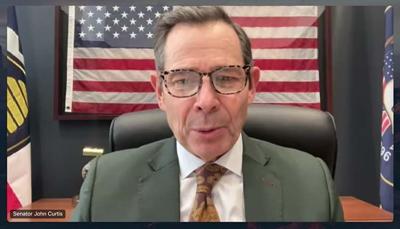


WASHINGTON, D.C. – With the federal government in the 40th day of the longest shutdown in history, Sen. John Curtis (R-UT) had a “modest proposal” that would avoid similar interruptions of federal services in the future.
“I have a bill that is brilliant, in my opinion, that would solve all of this …,” Curtis remarked in a virtual town hall meeting on Nov. 7 attended by more than 800 of his Utah constituents.
“It simply says when you do an appropriation, it doesn’t expire until you do the next appropriation, meaning that it would always stay active.”
But Curtis’ proposal may never see the light of day in Congress.
The inside-the-Beltway journal Politico reported on the evening of Nov. 9 that eight members of the Democratic caucus in the Senate voted to advance the House-passed stopgap funding measure, which is being used as a vehicle for the larger funding deal.
Those moderate Democrats agree to support a plan that would fund multiple agencies and programs throughout Fiscal 2026, in exchange for promises from President Donald Trump to rehire government workers fired on Oct. 1 and a floor vote in the Senate in December on legislation to extend Obamacare funding supplements.
With those breakaway Democrats adding their weight to that of Republicans, the Senate vote finally hit the 60-vote threshold for passage.
An appropriations bill allocates money to specific federal government departments, agencies and programs to fund operations, personnel, equipment and activities. Traditionally, regular appropriations bills are passed annually, with the funding they provide covering one fiscal year.
When Congress is unable to agree on appropriations, however, lawmakers typical resort to budget gimmicks like continuing resolutions, omnibus bills, reconciliation bills and other short-term fixes.
Continuing resolutions are temporary spending bills that allow federal government operations to continue when final appropriations have not been approved by Congress and the president.
It was a House-passed continuing resolution that 45 Senate Democrats rejected on Sept. 30 that plunged the federal government into its current shutdown.
In October, Curtis told KUTV News that Congress has only passed budget legisl time on four occasions since 1974.
“Every year,” he added, “we either go into a continuing resolution, a shutdown or both — and it always ends up with an omnibus, where we do our blowout spending.”
If his proposed legislation were enacted, Curtis says, Congress could never go into a shutdown again because, until there’s enough pressure to do a new appropriation, the previous one stays in effect, with no increase in federal spending.
Not surprisingly, many of the questions fielded by the Utah senator during the Nov. 7 virtual town hall concerned ways out of the historic budget crisis.
Trump had repeatedly called for Republicans to use the “nuclear option” to end the federal shutdown by legislatively removing the arcane filibuster rule in the Senate.
“A lot of senators feel strongly that we need to keep that 60-vote threshold,” Curtis countered in reply to a query from a constituent in his home base of Provo. “I’m one of them.”
Another question out of Provo concerned a court order by U.S. District Court Judge Jack McConnell of Rhode Island that would have required the Trump administration to immediately fund Supplemental Nutrition Assistance Benefits (SNAP) that expired on Nov. 1 to the tune of $4 billion.
SNAP is a federal program that provides monthly benefits to low-income households to help them purchase food.
Formerly known as "Food Stamps," SNAP is administered by state agencies using federally-funded benefits loaded onto Electronic Benefits Transfer Cards that are used like debit cards at grocery stores to buy eligible food items.
Some 42 million Americans receive some form of SNAP benefits.
“”I don’t know anyone that does not want to do everything possible to make sure we’re meeting those SNAP benefits,” Curtis replied during the virtual town hall.
“The worry is,” he added, “are the funds adequate, how long will the funds go and where do these funds come from? … At some point, as the shutdown goes on, we run out of those options as well, which is just one of the reasons why shutdowns are a bad idea to begin with.”
That federal order has since been paused by the U.S. Supreme Court, while the 1st Circuit U.S. Court of Appeals in Boston weighs an appeal from the administration.
As the town hall went on, Curtis emphasized the need to reform and protect Social Security as well as denying the false narrative that states like Utah can’t use protect public lands while simultaneously using them for recreation and other purposes.
He also politely objected to Trump’s use of executive orders to bypass Congress.
“When you go around Congress,” Curtis said, “you don’t get consensus.
“The best answer … is not to let the executive branch do that, but to put it into legislation. If it’s in legislation, that means that we had to find consensus between different groups. And I’m telling you, that we can find consensus.”
(0) comments
Welcome to the discussion.
Log In
Keep it Clean. Please avoid obscene, vulgar, lewd, racist or sexually-oriented language.
PLEASE TURN OFF YOUR CAPS LOCK.
Don't Threaten. Threats of harming another person will not be tolerated.
Be Truthful. Don't knowingly lie about anyone or anything.
Be Nice. No racism, sexism or any sort of -ism that is degrading to another person.
Be Proactive. Use the 'Report' link on each comment to let us know of abusive posts.
Share with Us. We'd love to hear eyewitness accounts, the history behind an article.